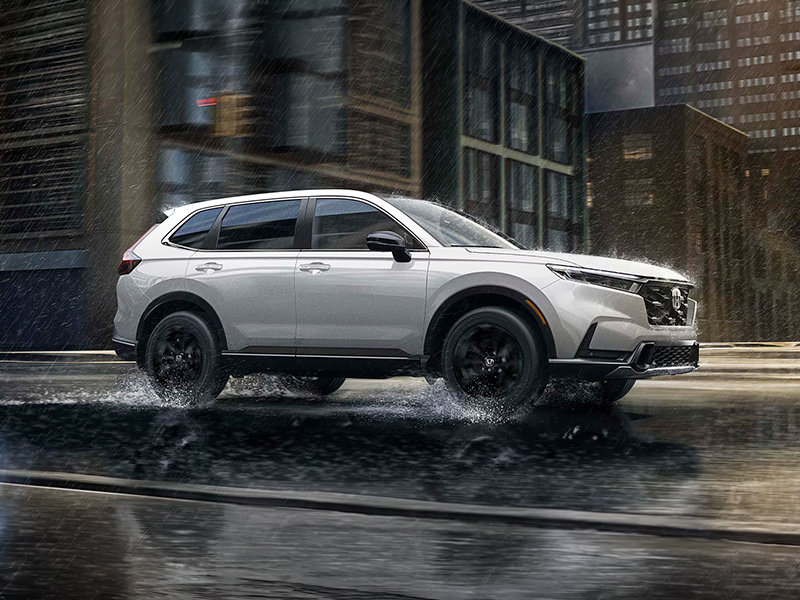

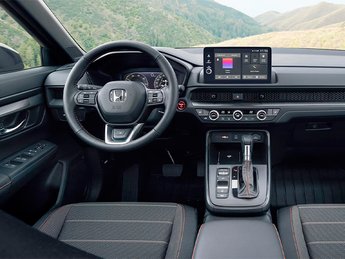
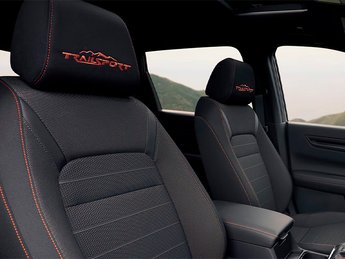
The 2027 Honda CR-V gives Canadian drivers two distinct ways to enjoy one of the country’s most versatile compact SUVs. Conventional gasoline models provide an accessible entry into the lineup, generous cargo capacity and straightforward performance. CR-V Hybrid models add more power, substantially lower fuel consumption and a broader selection of well-equipped trims.
Neither option is inherently the better choice for everyone. The right 2027 CR-V depends on where and how far you drive, the features you want and whether cargo capacity, towing ability or fuel economy carries the most weight in your decision.
Different Powertrains, Different Personalities
The gasoline-powered 2027 Honda CR-V uses a 1.5-litre turbocharged four-cylinder engine producing 190 horsepower and 179 lb-ft of torque. It is paired with a continuously variable transmission. The LX can be ordered with front-wheel drive or Honda’s Real Time AWD with Intelligent Control System, while the Sport receives all-wheel drive.
The CR-V Hybrid combines a 2.0-litre Atkinson-cycle four-cylinder engine with a two-motor hybrid system. Total output rises to 204 horsepower and 247 lb-ft of torque, with that torque available from 0 to 2,000 rpm. Every Canadian hybrid trim also comes with Real Time AWD.
That additional torque is noticeable in everyday driving. The hybrid powertrain responds promptly when leaving an intersection or accelerating into traffic, while its electric motors allow quieter and smoother operation at lower speeds. The gasoline engine delivers familiar, predictable performance and has more than enough output for commuting, highway travel and family use.
2027 Honda CR-V Gas and Hybrid at a Glance
|
Specification |
CR-V Gasoline |
CR-V Hybrid |
|---|---|---|
|
Engine |
1.5-litre turbo four-cylinder |
2.0-litre four-cylinder with two-motor hybrid system |
|
Combined output |
190 hp |
204 hp |
|
Torque |
179 lb-ft |
247 lb-ft |
|
Transmission |
CVT |
e-CVT |
|
Drivetrain |
Front-wheel drive or Real Time AWD |
Real Time AWD |
|
Best combined consumption |
7.8 L/100 km |
6.4 L/100 km |
|
Maximum cargo volume |
2,166 L |
2,030 L |
|
Available towing capacity |
680 kg |
453 kg |
The Main Differences to Remember
For shoppers comparing the two powertrains, the most important distinctions are straightforward:
- The CR-V Hybrid produces 14 more horsepower and 68 additional lb-ft of torque.
- Hybrid fuel consumption starts at 6.4 L/100 km combined with all-wheel drive.
- The gasoline LX 2WD achieves 7.8 L/100 km combined, while gasoline AWD models are rated at 8.4 L/100 km.
- The standard CR-V offers more cargo capacity and a higher available towing rating.
- Every hybrid model includes all-wheel drive and a Sport driving mode.
- The hybrid range offers four trims, including the adventure-oriented TrailSport Hybrid.
- Neither version needs premium fuel; Honda recommends regular gasoline throughout the lineup.
- CR-V Hybrid models recharge their battery while driving and do not need to be plugged in.
Fuel Economy Can Make a Meaningful Difference
The hybrid’s greatest practical advantage is its efficiency, particularly in urban driving. The Sport Hybrid, EX-L Hybrid and Touring Hybrid are rated at 6.0 L/100 km in the city, 6.9 on the highway and 6.4 combined. The TrailSport Hybrid’s all-terrain tires contribute to ratings of 6.3 city, 7.2 highway and 6.7 combined.
By comparison, the gasoline LX with front-wheel drive is rated at 8.4 L/100 km in the city, 7.1 on the highway and 7.8 combined. Gasoline models with all-wheel drive are rated at 9.1 city, 7.6 highway and 8.4 combined.
Because hybrid systems can recover energy during deceleration and rely more frequently on electric assistance at lower speeds, the efficiency advantage is especially relevant to drivers who encounter regular stop-and-go traffic. Highway-focused drivers will still save fuel with the hybrid, although the difference is less pronounced than it is in town.
Cargo Space and Towing
The CR-V’s practicality remains a major strength with either powertrain. Gasoline models provide 1,113 litres of cargo volume behind the rear seats and as much as 2,166 litres with them folded. Hybrid models offer 1,028 and 2,030 litres, respectively.
Both versions seat five and provide an impressive 1,042 mm of second-row legroom. The modest difference in cargo capacity results from the hybrid system’s packaging rather than a reduction in passenger space.
Drivers planning to tow should also note that gasoline models can pull up to 680 kg when fitted with the required accessory towing package. Hybrid models are rated for up to 453 kg. Both are suitable for modest recreational equipment, but the gasoline CR-V offers additional flexibility for owners who expect to tow regularly.
Choosing the Right 2027 CR-V
The gasoline CR-V makes sense for drivers seeking a lower entry point, maximum cargo capacity or the lineup’s highest towing rating. The availability of front-wheel drive on the LX also gives shoppers an efficient alternative when all-wheel drive is not essential.
The CR-V Hybrid is particularly appealing for higher-mileage drivers, urban commuters and shoppers who want stronger low-speed response. Its four-trim selection ranges from the accessible Sport Hybrid to the rugged TrailSport Hybrid and well-appointed EX-L Hybrid and Touring Hybrid.
Regardless of the powertrain selected, the 2027 Honda CR-V remains spacious, composed and well suited to Canadian life. The best way to decide between them is to drive both at Century Honda and compare how their performance, features and efficiency fit your daily routine.